Fig Leaf Cover
Don't Leave God Alone: How to Get God's Attention, Remain in His Presence, and Even Change His Mind to Make a Difference in Your WorldThe Fig-Leaf Remedy is a metaphor for the human attempt to hide spiritual failure behind self-justification, substitute practices, and outward religious activity. Its decisive significance is that it appears to offer safety while leaving the underlying separation from God untouched: the remedy covers shame but produces no fruit, replaces divine presence with human effort, and must finally be abandoned in favor of returning openly to God.
Origin in Shame and Hiding
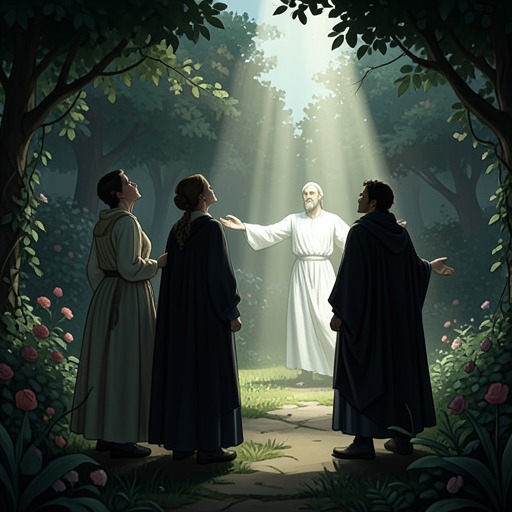
The image begins with Adam and Eve after their sin. They had been accustomed to walking with God and being clothed with His presence, although they had always been physically naked. Once they sinned, they felt exposed, became embarrassed, and wanted to hide from God. They sewed fig leaves together and made them their covering, placing a handmade barrier between themselves and the presence they had previously enjoyed.
The covering therefore represents more than an article of clothing. It is the visible form of a withdrawal from fellowship. Sin and compromise produce shame, and shame encourages people to stay away from God because concealment feels safer than confession. The book applies this pattern to Christians who miss prayer, surrender to distraction, or believe they have disappointed God: instead of returning to Him, they avoid prayer and construct excuses that allow them to feel temporarily justified.
Self-Righteousness Without Fruit
The book defines fig leaves as human efforts toward righteousness—works assembled to make a person feel justified in actions that cannot withstand God’s presence. Such efforts cannot provide a legitimate basis for approaching God. They may make failure less uncomfortable, but they do not restore communion, change the heart, or produce spiritual fruit.
The same symbolism is connected with Jesus Christ’s cursing of the fig tree. He found the tree without fruit, and the book interprets it prophetically as recalling the fig leaves Adam and Eve used in place of God’s presence. Their covering had produced no fruit, just as a self-made covering remains a fruitless response to failure. The lesson is not to perfect the disguise but to return to God, where failure can be addressed and prayer can move from inconsistency toward a fruitful and steady life.
The fig tree is also linked to Jesus Christ’s cleansing of the Temple. After observing the Temple and cursing the fruitless tree, He drove out the money changers and those selling doves; in other accounts, He also removed sellers of oxen and sheep. The book reads these actions as a confrontation with human methods replacing God’s presence. Selling doves is treated as an image of substituting human technique for the anointing of the Holy Spirit, while the working oxen and the sheep associated with God’s people represent service and people that are not themselves evil. What must be removed is the replacement of divine presence with man-made systems.
Returning Instead of Retreating
The alternative to the Fig-Leaf Remedy is direct movement toward God. When people feel that they have failed or have left God alone, the book urges them not to run from Him but to run straight back to Him. Because of Jesus Christ’s blood, sin can be covered without dependence on a handmade fig leaf. The required response is openness rather than excuse-making and continued return rather than withdrawal.
This return is presented as a repeated discipline. A person may fail in prayer again and again, yet failure is not treated as a reason to abandon prayer. The book’s larger principle is that God is within reach and that persistence matters even when the answer seems distant. Jacob’s struggle at Peniel is used to show determination that continues until blessing is received; the point is not that the answer was absent, but that Jacob had to press toward the God who was already near.
The same logic appears in the teaching to ask, seek, and knock. Persistence in prayer means continuing to ask when no answer seems visible, continuing to seek when circumstances suggest that nothing is changing, and continuing to knock when the doors of heaven appear closed. The refusal to quit is what the book says releases blessing. In this framework, leaving God alone is not spiritual maturity or resignation; it is the abandonment of the relationship through which help, correction, and change are expected to come.
Substitutes for Presence
The metaphor extends beyond private shame to public religious life and collective crisis. The book warns that lifeless religion results when substitutes for God’s presence are allowed to stand in His place. Such substitutes may preserve an appearance of order or righteousness, but they leave little or no fruit because they depend on human methods rather than God’s way of doing things.
The contrast is especially clear in the book’s treatment of prayer during danger. After the September 11 attacks, churches and prayer meetings filled as people sought God amid uncertainty, but the renewed hunger lasted only a short time. The book describes this pattern as risky: people may treat Jesus Christ as Savior in catastrophe while refusing to make Him Lord through regular commitment. Prayer driven only by tragedy leaves people on a dangerous edge, whereas daily fellowship places dependence on God before the next crisis arrives.
The same argument is applied to war. The rapid seizure of Baghdad by American troops after twenty-one days is contrasted with the later period of military deaths and widespread violence. The book attributes the difference, in part, to people ceasing to pray for those serving in the military. An initial mandate of prayer had provided coverage, but when the matter became less urgent, the nation had effectively left God alone. Whether in war, public violence, or spiritual disorder, the book presents prayer as active involvement rather than a last-minute emergency measure.
Prayer as the Living Alternative
The book’s examples of storms and illness show why the Fig-Leaf Remedy cannot be replaced by passive religious language. In 2004, during a conference in Jacksonville, Florida, Hank Kunneman prophesied that Florida would face two consecutive hurricanes and that prayer could keep them away. People prayed, but the hurricanes still came, demonstrating that an initial effort had not ended the need for persistence. The following year, hundreds prayed with greater fervency over a named storm expected before another conference, and the storm did not strike them. The difference is presented as determination that refused to accept a negative answer.
The pattern is extended to 2006, after record hurricane years. People collectively, individually, and fervently prayed and declared peace over the storms; no major hurricane struck the United States that year, although some storms attempted and failed to do so. In the book’s interpretation, this is what happens when people stop hiding behind a substitute and rise into sustained involvement with God.
A tornado account makes the same point through contrasting outcomes. In one storm, the tornado was reportedly less than a mile from the house; Hank Kunneman and Brenda Kunneman spoke against it, but a large branch struck the house and they ran to the basement. They later laughed at their inadequate response. In another storm near a medical office building, they told nearby doctors that Jesus Christ would calm the storm and spoke to it before going indoors; the tornado rose back into the sky and the storm dissipated. The earlier disappointment did not make them abandon the practice of speaking in faith, and the book uses both incidents to emphasize progressive growth rather than a flawless first attempt.
The family medical crisis involving Brenda Kunneman’s father gives the metaphor its most severe setting. After an unexplained fever began during a July 4 camping trip, returned in December, and led to an ambulance transfer, emergency surgery discovered diverticulitis and a ruptured bowel. Months of undetected infection had produced septic shock. His body swelled to three times its normal size, his temperature reached 105 degrees, and he required a medical coma, dialysis, a ventilator, and nineteen intravenous bags while his liver, kidneys, and lungs began to fail. Eight physicians treated him, and the surgeon estimated less than a 50 percent chance of survival. Instead of retreating behind fear or resignation, the family entered sustained prayer around the clock, treating persistence as the living practice that keeps them turned toward God in the face of apparent impossibility.
The metaphor ultimately belongs to a wider pattern of resurrection and release. A dream may appear dead, yet persistent prayer can continue until it comes back to life. After the dream emerges, however, old habits can remain like Lazarus’s graveclothes: bound hands restrict service and work, bound feet revive past sins and cause repeated falls, and the cloth around the face obstructs vision, speech, hearing, and thought. The hands, feet, eyes, mouth, ears, and mind each describe a way that a person can be restored outwardly while still living according to the past. The dream’s resurrection is therefore not the end; the graveclothes must also be removed.
The Fig-Leaf Remedy is rejected because it conceals rather than transforms. Its covering is shame’s architecture, built from excuses, self-righteous works, and substitutes for the presence of God. The book’s answer is the opposite movement: return after failure, press toward God when the answer seems delayed, ask and keep asking, seek and keep seeking, knock and keep knocking, and remain engaged in prayer before crisis forces the issue. Where the fig leaf leaves a person covered but fruitless, persistent fellowship opens the way to change, blessing, and a life no longer separated from God’s presence.